01
Acquisition & checkout
WordPress marketing presence with Stripe subscription checkout in a validated test payment flow.
Flagship case study
AI Receptionist & Business Automation SaaS
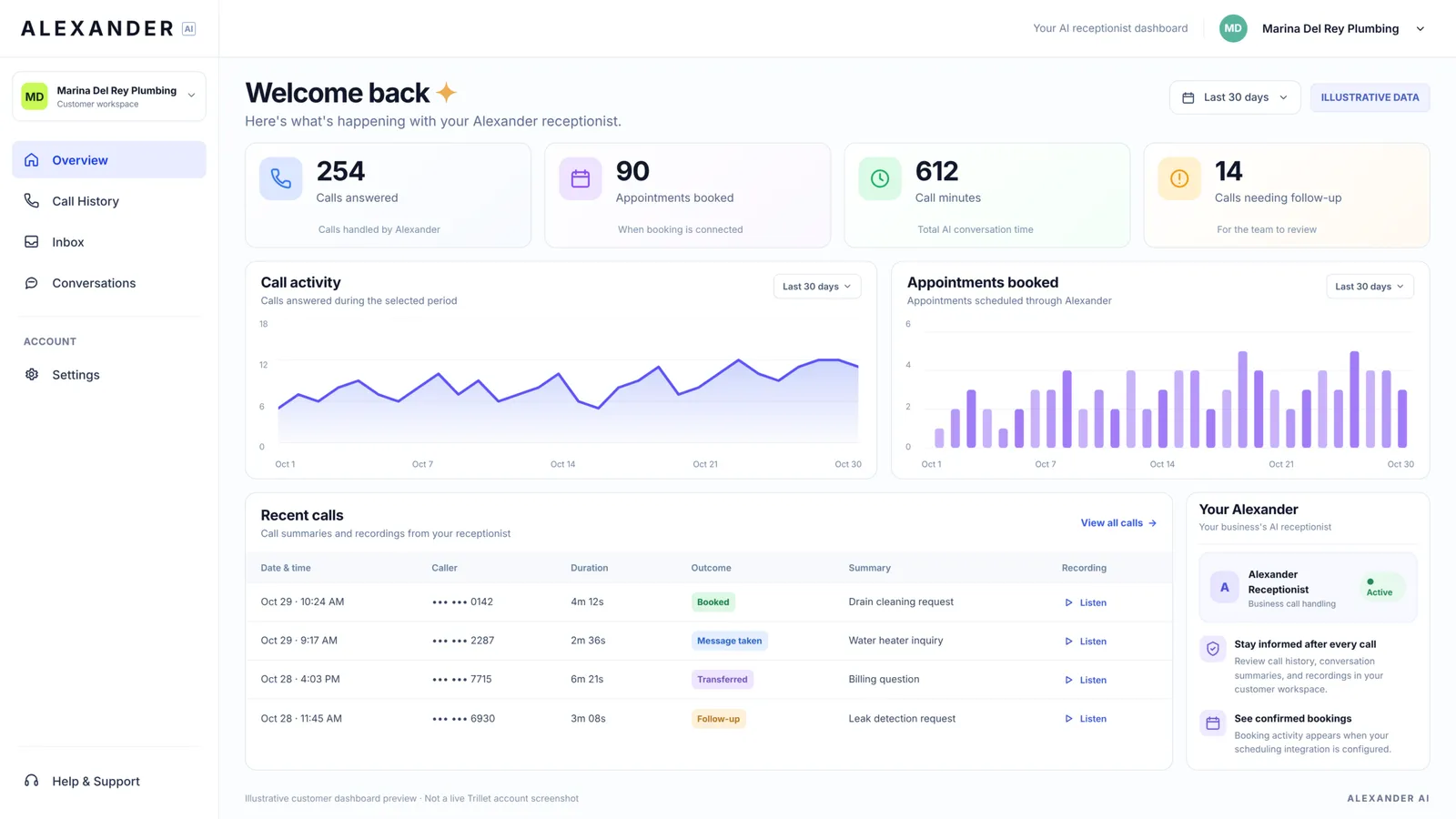
A business-aware AI receptionist platform for U.S. plumbing companies — connecting subscription onboarding, structured company policy, conversational voice AI, service-request capture, and operational workflows.
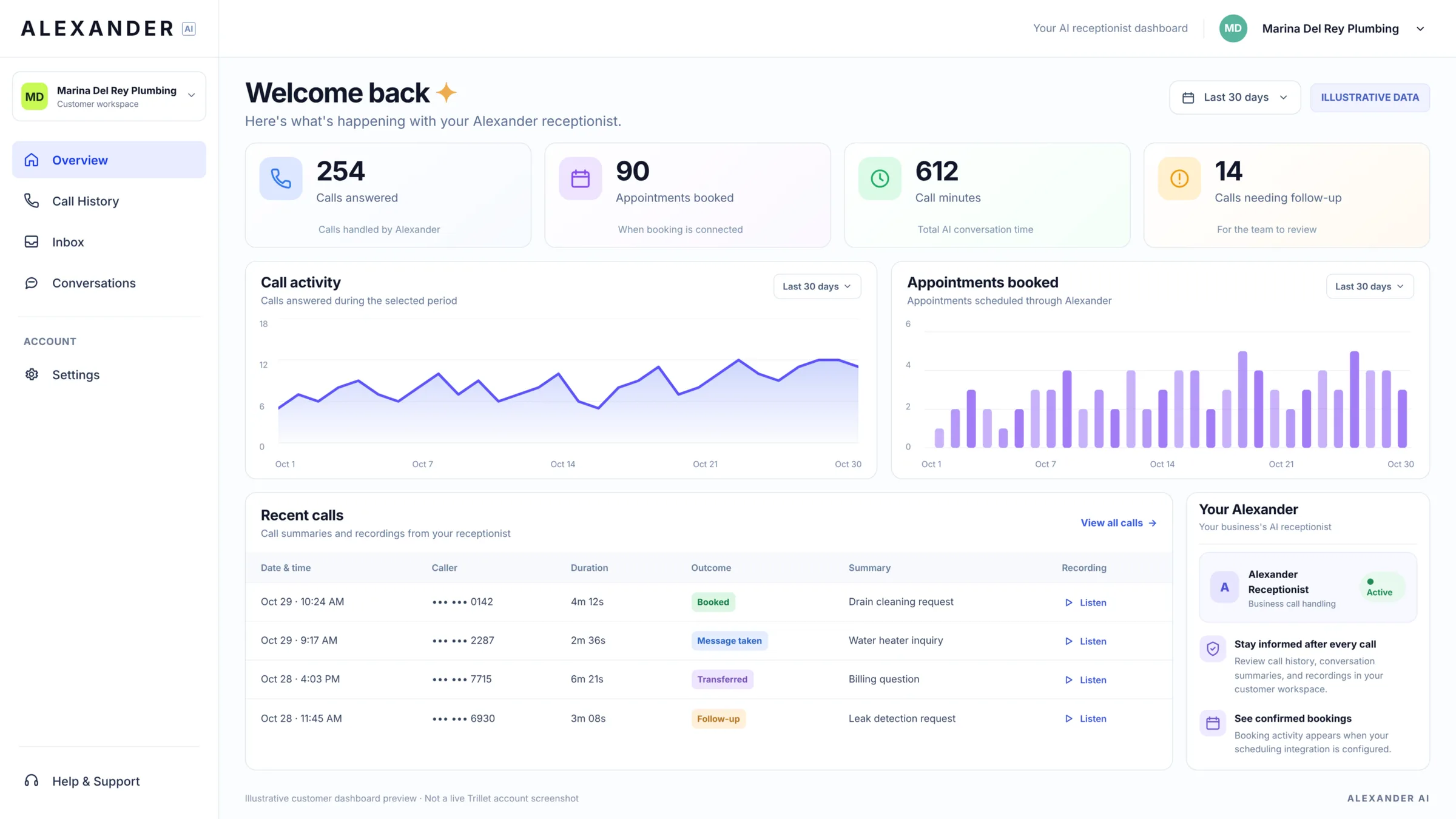
01 / Challenge
Missed calls, unsafe improvisation, and unstructured transcripts create operational risk. Alexander was designed so the AI can only act within verified company policy and confirmed system capability.
Field teams and closed offices leave inbound inquiries unanswered — especially outside business hours — while urgent callers still need a truthful next step.
A public website cannot encode ZIP coverage, tenant authorization, travel fees, emergency contacts, or booking authority. The receptionist must use approved business facts, not guesses.
Arrival times, bookings, pricing, warranties, and dispatch claims must be gated by policy and confirmed system state — never invented mid-call.
Plumbing operators need structured caller context, urgency, callbacks, and request records that can move into operational systems safely.
Scaling requires payment verification, secure onboarding, versioned company profiles, tenant isolation, recoverable failures, and bounded integrations.
02 / Solution
Acquisition, configuration, voice, backend operations, and integrations are designed as connected systems with explicit failure boundaries — not a single monolithic chatbot.
01
WordPress marketing presence with Stripe subscription checkout in a validated test payment flow.
02
Eight-section Next.js questionnaire with conditional questions, save/resume, validation, and canonical company policy persistence.
03
Trillet-hosted conversational agents with business-specific instructions, real call tests, structured extraction, and human handoff rules.
04
AWS-backed customer lifecycle, immutable submissions, profile revisions, SES communications, and completed-call request handling.
05
Jobber and Google Calendar connectors designed with staged testing, permission checks, and no-false-success safeguards.
03 / Contributions
Technical leadership and hands-on implementation across product architecture, full-stack delivery, voice configuration, integrations, and QA — not a claim that one person exclusively authored every line of every subsystem.
Defined how marketing, Stripe, Next.js onboarding, AWS persistence, Trillet voice, and external tools form one SaaS journey with explicit boundaries.
Built and coordinated the Next.js/TypeScript onboarding app, server routes, signed access, autosave/resume, validation, submission, and Vercel/AWS deployment paths.
Designed customer identity, immutable questionnaire submissions, canonical profiles and revisions, duplicate-safe writes, and recovery-friendly state transitions.
Configured Trillet agents and call flows; validated real conversations, summaries, and extraction; designed emergency, pricing, booking, and escalation boundaries.
Worked Stripe test checkout, SES messaging, completed-call ingestion, Jobber test connection, and Google Calendar QA — keeping authority separate from execution proof.
Defined acceptance flows, idempotency and isolation checks, and truthful failure handling rather than declaring the full platform finished prematurely.
04 / Architecture
WordPress owns acquisition. Next.js owns business workflows. PostgreSQL owns canonical state. Trillet runs the voice experience. Integrations remain permission-bound and only claim success after confirmation.
Marketing, education, and conversion entry — not the SaaS source of truth.
Secure onboarding UX, validation, save/resume, and application API routes on Vercel.
Lifecycle processing, canonical relational state via RDS/RDS Proxy, and immutable submission artifacts.
Welcome/onboarding and setup-related transactional messaging with staged production-domain QA.
Hosted voice agents, call flows, knowledge, and conversational transport for receptionist experiences.
Billing, field-service CRM, and scheduling pathways — verified only where permissions and writes are proven.
Frozen questionnaire specification (October 4, 2026): eight sections that capture company facts, services, emergencies, scheduling, pricing, customer care, voice preferences, and integration setup — so Alexander uses approved policy instead of guessing.
137 counts registered logical IDs in the frozen specification — not 137 questions shown to every company. Conditional fields appear only when relevant.
04B / System map
Acquisition, configuration, canonical data, voice, and operations are separated on purpose. Dashed nodes are integration pathways still in staged QA — not claimed as fully verified production automation.
WordPress
Marketing / WP Engine
Stripe
Test checkout verified
Next.js
Onboarding on Vercel
AWS Lambda
Lifecycle + routes
PostgreSQL
Canonical company state
Amazon S3
Immutable artifacts
Amazon SES
Lifecycle email
Company Truth
Versioned policies
Trillet Voice
Agent + call flow
Call Ingestion
Idempotent requests
Request Dashboard
Staging operations
Jobber
Test / restricted
Google Calendar
Availability QA
Fig. 03 — Conceptual architecture · secrets and private network details omitted
05 / Stack
A multi-system stack spanning marketing, SaaS application delivery, cloud persistence, conversational voice, billing, and field-service integrations.
06 / Outcomes & status
Built and validated the core technical foundation for a business-specific AI receptionist SaaS — custom onboarding, cloud persistence, voice-agent call handling, structured call data, and operational request-management groundwork. Continued work focuses on fully automated provisioning, verified customer access, provider integration QA, and production activation.
Case Study 002
Next case studyDiscuss a similar AI SaaS build?
zaidduartee@gmail.com ↗