Layer 01
Compatible Proxy
OpenAI-compatible ingress for existing HTTP clients and SDKs with endpoint-level integration.
LLM Inference
Optimization Infrastructure
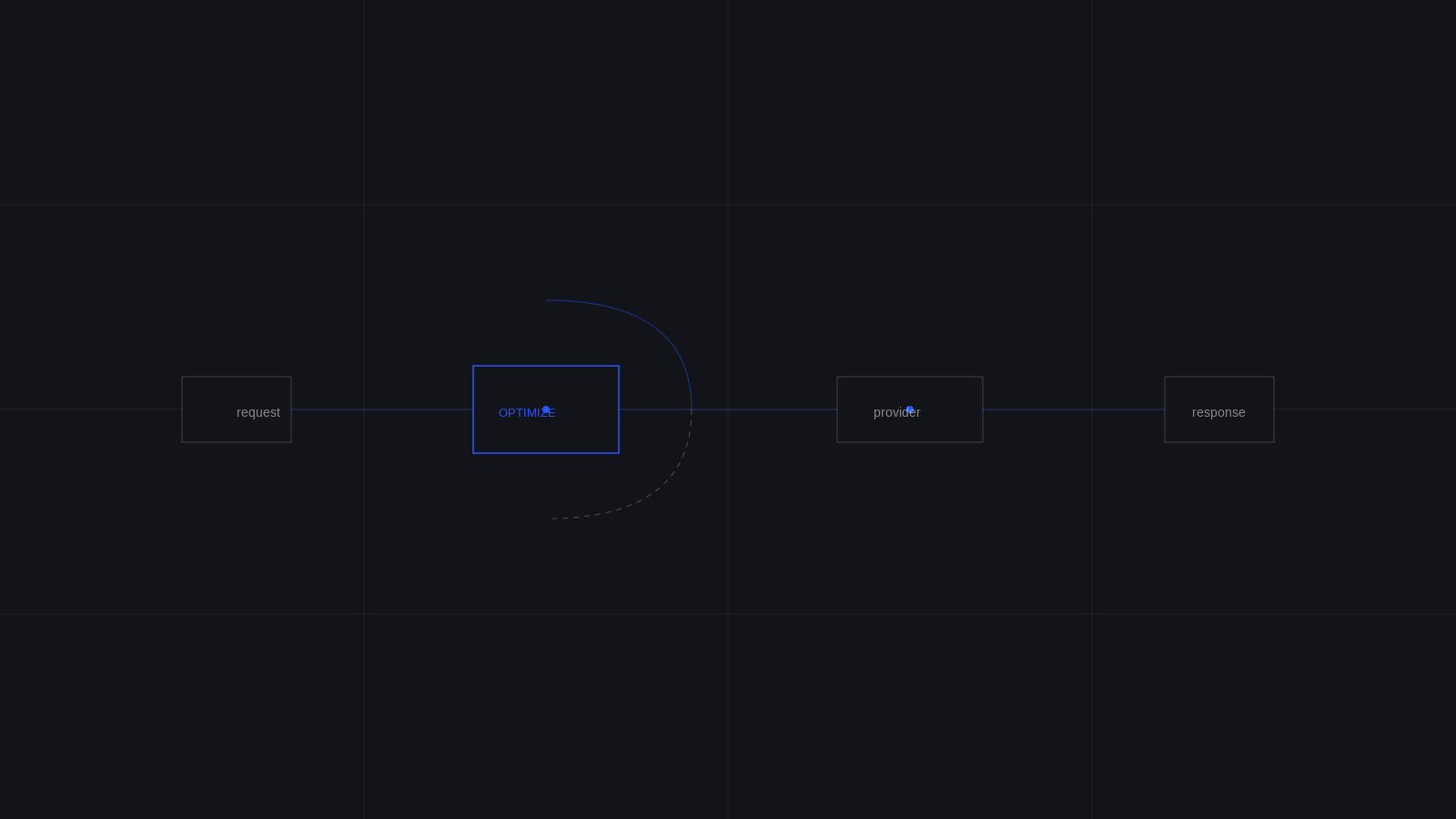
An OpenAI-compatible inference optimization system that evaluates request-level optimization strategies, applies only defensible changes, and preserves the original request when confidence is insufficient.
Technical implementation is complete within the documented system scope. No claims are made about customer adoption, achieved cost savings or commercial performance.
Fig. 01 — Request path
01 / The Cost of Inference
AI-native products depend on LLM APIs for core functionality. As adoption increases, inference spending directly compresses gross margins — even when providers reduce token prices over time.
The problem is not only expensive models. It is avoidable waste: repeated identical requests, duplicated context, unnecessarily long histories, poor cache structure, and synchronous execution of batch-eligible work.
Using the most capable model for every request is rarely the most economical choice — but manual optimization does not scale across production traffic.
02 / The Optimization Gap
Cost visibility alone does not eliminate inefficiency. MarginAI separates visibility, recommendation, automated decision-making, execution, and verification — with automation applied only where safety thresholds are met.
01 / Visibility
Token spend and repeated request patterns are captured at ingress.
02 / Recommendation
Candidate optimizations are identified before any transformation is applied.
03 / Automated decision
Only changes that pass independent safety checks are applied.
04 / Execution
Optimized or original requests forward through a compatible proxy path.
05 / Verification
Decisions, usage, and modeled cost impact are recorded for audit and billing.
03 / What MarginAI Is
Built as an OpenAI-compatible API proxy that evaluates each request against controlled optimization strategies and forwards the original payload unchanged whenever modeled impact cannot be justified with sufficient confidence.
04 / My Role
Translated inference-cost goals into a scoped system with explicit safety boundaries.
Built proxy compatibility, optimization engine, metering, and production reliability paths.
Implemented auth provisioning, usage ledger, dashboard, and audit observability.
05 / Decision Model
Each request is evaluated against independent criteria. If safe optimization cannot be established, the original request forwards unchanged — fail-open by design.
Can this request be optimized safely?
Yes — high confidence
Only validated transformations — each strategy operates independently.
No — insufficient confidence
Original request and response path preserved exactly.
Will the transformation materially change model behavior?
Does the request require synchronous response?
Are input tokens reducible without losing required context?
Can the optimization fail open to the original request?
Does history trimming risk removing dependencies?
Do tools, parameters, or streaming constraints apply?
Is the customer configuration compatible with this strategy?
06 / System Architecture
A public-safe architecture view — compatible ingress, optimization engine, provider forwarding, and modeled cost attribution.
01
OpenAI-compatible ingress for existing HTTP clients and SDKs with endpoint-level integration.
02
API-key validation, organization boundaries, usage capture, and request identity.
03
Independent evaluators for each strategy with per-strategy confidence thresholds.
04
Optimized or pass-through requests sent to the LLM provider with streaming support.
05
Token accounting, baseline-versus-candidate comparison, billing events, and dashboard metrics.
07 / Optimization Strategies
The MVP deliberately excludes model routing and autonomous rewriting. Each strategy below operates independently and bypasses when its safety requirements are not met.
01
Return a cached response when an identical eligible request was already processed.
Cost avoidance and lower latency for cache-safe workloads.
02
Detect repeated system prompts or context blocks and remove redundant tokens.
Reduces input-token waste without removing semantic information.
03
Remove older messages only when confidence is high they no longer affect the current turn.
Controls long-history cost while preserving tool context when uncertain.
04
Structure stable prompt prefixes to benefit from provider-side prompt caching.
Structural optimization — not unrestricted semantic rewriting.
05
Identify workloads that may suit asynchronous batch pathways when explicitly enabled.
Applied only when latency contracts allow — never silently by default.
08 / Safety & Fail-Open
If any required guarantee cannot be established, the original request follows the unchanged path to the provider.
Never modify a request unless optimization confidence is sufficiently high.
Cost reduction is unacceptable if it meaningfully changes response quality or application behavior.
Applications change one API endpoint — not their core architecture.
Optimization runs automatically without continuous manual tuning.
Modeled cost impact, processed tokens, and fees remain measurable.
09 / Request Flow
Before
provider API endpoint
Replace
endpoint →
After
MarginAI proxy endpoint
01
Validate compatibility and capture baseline token estimates.
02
Run each optimization independently against safety thresholds.
03
Transform only validated changes; otherwise preserve the original payload.
04
Send optimized or unchanged requests with streaming support.
05
Log usage, modeled cost impact, and return the provider response.
10 / Platform Experience
GitHub authentication, automatic provisioning, and a dashboard focused on modeled cost impact rather than overwhelming analytics.
01
GitHub sign-in with automatic user and organization provisioning.
02
Swap the OpenAI base URL for the MarginAI proxy endpoint.
03
Dashboard surfaces usage, eliminated tokens, and modeled cost impact.
Dashboard focus
11 / Governance & Scope
Governance Principles
Prefer zero cost reduction over unsafe optimization — the original request path always remains available.
Each optimization disables itself independently when its confidence threshold is not met.
Request IDs, structured logs, and optimization decision records support post-hoc review.
Token accounting and cost-difference calculations are reproducible for invoicing.
Encrypted keys, HTTPS-only traffic, no secrets in logs, and strict organization separation.
The system excludes features that would dilute the core optimization proof point.
Explicitly excluded from MVP
12 / Technology
13 / Trade-offs
Aggressive optimization lowers cost but risks silent behavior change — the system biases toward conservative bypass.
Evaluation and rewriting add proxy overhead; optimizations must justify their cost.
Automatic optimization reduces operational burden but requires transparent decision records when strategies bypass.
A general AI gateway would expand scope — this system optimizes inference economics only.
14 / Technical Delivery
Technical implementation is complete within the documented system scope. No claims are made about customer adoption, achieved cost savings or commercial performance.
API proxy
OpenAI-compatible ingress with endpoint-level integration, error handling, and pass-through forwarding.
Compatibility layer
HTTP client and SDK support within a defined compatibility scope — not unrestricted provider parity.
Optimization engine
Five request-level strategies evaluated independently with per-strategy confidence thresholds.
Independent safety gates
Each strategy applies only when its safety checks pass; otherwise the original payload is preserved.
Fail-open path
Insufficient confidence always routes the unmodified request to the provider.
Auth & org provisioning
GitHub OAuth, automatic organization creation, and API-key issuance.
Usage & cost-impact ledger
Token accounting, baseline-versus-candidate comparison, and billing event capture.
Dashboard
Usage metrics, eliminated tokens, modeled cost impact, and optimization status.
Audit & observability
Request IDs, structured logs, optimization decision records, and post-hoc review support.
15 / Reflection
“The product lesson was constraint: an optimization layer in the request path cannot afford to be clever at the expense of trust. MarginAI only works if engineers believe that when the system is uncertain, their request is identical to what they would have sent directly — and that belief has to be engineered, not marketed.”
— Zaid Duartee
Inference optimization only matters if engineers trust the path their requests take. MarginAI was architected around that trust first — cost efficiency second.
Case / 005
MarginAI
Case Study 004
Previous SystemHave a reason to talk?
zaidduartee@gmail.com ↗